The Mohatta Palace, Pakistan.
It is located in Karachi, Pakistan. It was built by Shivratan Chandraratan Mohatta. The palace has an area of 18,500 sq ft [1,720 m2] and its facade is trimmed with windows, stone brackets, spandrels, domes, balustrades with floral motifs and exquisite railings. The "barsati” (terrace) of the Mohatta Palace had a beautiful family temple dedicated to Hindu God, lord Shiva.
What many do not know about the Mohatta Palace is the secret underground tunnel that leads from the grounds of the palace all the way to a subterranean Hindu temple less than a kilometer away. Various stories allege the presence of supernatural happenings at the Mohatta Palace as well!
Darbar Mahal, Pakistan.
Darbar Mehal is one of the hidden gems of Bahawalpur, since not many know about it. It was built in 1872 like an Italian chateau on neoclassical lines, at a time when modernism had set in. It belonged to the Nawab of Bahawalpur princely state, during British Raj.
The Faiz Mahal, Pakistan.
Commissioned by Talpur dynasty, it is reminiscent of the glory days of Khairpur state. It was built in 1798 as the palace of the Talpur family.
Kachura Lake, Pakistan.
Skardu, Gilgit-Baltistan
Max. depth 70 metres [230 ft]
Surface elevation 2,500 metres [8,200 ft]
The Kachura Lakes are two lakes in the Skardu District of Gilgit-Baltistan, northern Pakistan. The lakes are in the Karakoram mountain range of the western Himalayas, the greater Kashmir region, and in the Indus River basin.
Rohtas Fort, Pakistan.
Rohtas Fort is a formidable structure built over hillocks and looking out at what is left of Jhelum river, Grand Trunk Road runs from Calcutta to Kabul. It is one of the best known highways of the ancient times and still lot of travelers wish to travel by it.
Today, Rohtas is the pride of Pakistan and one of the eight World Heritage Sites of UNESCO.
The Kingdom which is seldom visited known as Karakorum, Pakistan.
The Karakoram and the Himalaya are important to Earth scientists for several reasons. They are one of the world's most geologically active areas, at the boundary between two colliding continents. Therefore, they are important in the study of plate tectonics.
A significant part, 28-50% of the Karakoram Range is glaciated, compared to the Himalaya (8-12%) and European Alps (2.2%). Mountain glaciers may serve as an indicator of climate change, advancing and receding with long-term changes in temperature and precipitation.
Silk route, on the way to Gilgit, Pakistan.
For centuries, Gilgit has been the stopping point on the Silk Route as caravans journeyed south from Kashgar. Chinese monks returning from pilgrimages in India in the 5th century found Buddhism widely practiced in Gilgit. Hinduism came to the area around the 10th century, followed by Islam two hundred years ago.
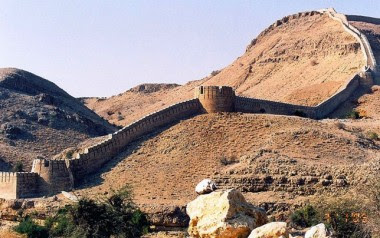
Is this Great Wall of China?
No. It's Wall of Sindh in Ranikot [3 hrs drive from Karachi].
It's the part of one of the Largest Fort in World, Fort of Ranikot.
This is an amazing view of a tunnel and bridge over a river on the railway track from "Rohri to Quetta".
This track passes through 20 tunnels and over 368 bridges.
It's the longest Railway gradient of world, and most scenic Railway ride of Asia.
This track also extends from Quetta to Turkey through Iran!
Is this Grand Canyon or Texas?
No. It's Hingol National Park of Baluchistan, Pakistan. It got Mysterious Mud mountains, beautiful blue water Hingol river, desert and deep blue Arabian sea. [3.5 hrs drive from Karachi on Makran coastal highway.
The Grand Canyons of Sindh,
And finally, something you don’t get to see everyday, a snapshot from my facebook wall. Something worth sending jitters down the spine! J