Showing posts with label Pakistan. Show all posts

Thursday, November 28, 2013

Pakistani startup raises $5m from venture capitalist

Karachi: In what can serve as an inspiration for the country’s tech firms seeking expansion in the world’s largest market, Pakistani start-up ‘Convo’ has raised $5 million in investment capital from a top tier venture capitalist (VC) in Silicon Valley. It is, arguably, the first Pakistani company to receive such major funding from an institutional VC firm in the world’s IT hub.
This is Convo’s first major investment from Morgenthaler Ventures, one of the top institutional VC companies in the Valley, which has investments in over 300 companies including tech giant Apple Incorporated.
VC firms are private investors that provide financial capital to early-stage, high-potential, high-risk, growth startup companies. The investment, therefore, reflects Morgenthaler’s confidence in the product.
“We have been amazed at the level of engagement we have seen from Convo’s early customers, including many global brands. These organisations won’t settle for inconsistent, light-weight solutions,” Rebecca Lynn, Partner at Morgenthaler Ventures said. “There are collaboration services you use to run chit chat, and there are those that run your company. Convo is relied on for the latter,” she said.
convo

Pakistani scientist features on leading American journal

KARACHI: A leading American science magazine has listed a technology by a Pakistani scientist in its ‘World Changing Idea’ list– the magazine’s annual feature for the recognition of the world’s top ten technologies that have potential to change the world.
On November 19, Scientific American – a reputable science journal based in the United States (US) – recognised Muhammad Hamid Zaman, a Pakistani biomedical engineer, for his innovative product Pharmacheck, which was chosen by the magazine as one of the world’s top 10 technologies for its December, 2013 issue.
Every year, the magazine chooses 10 technologies that have the potential to change the world and publish this list. The selection process, Zaman told The Express Tribune, is controlled only by the journal and no one can nominate himself as they make their own selections based on the potential impact of the discovery or technology.

Monday, September 2, 2013

47 A's - World record in O-A level exam


http://i.dawn.com/large/2013/09/5222b09a228d2.jpg


ISLAMABAD: A Pakistani student, Haroon Tariq, has broken the current world record by securing a total of 47 As in his International General Certificate of Secondary Education (IGCSE) O Level and A Level exams from the University of Cambridge International Examinations.
His subjects spanned both the humanities and sciences including Human and Social Biology, Islamic Religion and Culture, Physics, Chemistry and Global Development.
A student of Froebel’s International School (FIS), Haroon Tariq’s achievement had put Pakistan in the global spotlight.
In the O Levels, the previous world record was 28 As which was also held by a Pakistani student Zohaib Asad. However, Haroon Tariq obtained 38 As in O levels and a total of 47As in his O and A level exams.
While talking to Dawn, Haroon Tariq said he studied 50 different subjects in O and A levels during the span of three years. He said obtaining 47 As was not easy as he had to study different languages including Spanish and French.
“I want to study engineering in the future, but have not decided whether to specialise in software engineering or aeronautical engineering,” he said.
Haroon Tariq said his teachers guided him well due to which he achieved the remarkable score, adding that he had to give all his attention to his studies.
Head Principal of the school Shahmina Kamal said, “I feel honoured to be instrumental in shaping a competent youngster for tomorrow’s Pakistan.” Similarly, the head of the Dept of Examinations Sahar Pirzada said, “I always remind students that success is a state of mind. They need to trust themselves as they always know more than what they think they do.”
“Surely enough, we have students setting world records for academic excellence,” she said.

Monday, August 19, 2013

Nofil remains Asia’s No 1 U-14 player

ISLAMABAD - Syed Nofil Kaleem continues enjoying No 1 ranking in U-14 category not only in Pakistan but also in Asia, which is a great honuor for the country and entire nation. 
According to the latest rankings issued by Asian Tennis Federation (ATF) on July 29, Nofil with total 1,365 points continues to be on the top of the rankings. He is the first Pakistani to become Asian U-14 champion after playing in eight tournaments in which he won two ATF singles titles, remained runner-up in three and winning three doubles titles. The young lad distinctly excelled and produced consistent performances, which helped him in retaining the top slot.
In an exclusive interview with The Nation on Saturday, Nofil said: “I am now targeting the ITF juniors and intend to participate in the circuit this year to play in Jordan, South Africa, Kuwait, Bahrain and Colombo. I have completely stopped in participating in U-14 features and now regularly playing juniors U-18 as well as seniors event at the national level.”
nofil

Thursday, May 16, 2013

Pakistan, remarkably tolerant racially, Research Says.


A fascinating map of the world’s most and least racially tolerant countries


Click to enlarge. Data source: World Values Survey

When two Swedish economists set out to examine whether economic freedom made people any more or less racist, they knew how they would gauge economic freedom, but they needed to find a way to measure a country’s level of racial tolerance. So they turned to something called the World Values Survey, which has been measuring global attitudes and opinions for decades.
Among the dozens of questions that World Values asks, the Swedish economists found one that, they believe, could be a pretty good indicator of tolerance for other races. The survey asked respondents in more than 80 different countries to identify kinds of people they would not want as neighbors. Some respondents, picking from a list, chose “people of a different race.” The more frequently that people in a given country say they don’t want neighbors from other races, the economists reasoned, the less racially tolerant you could call that society. (The study concluded that economic freedom had no correlation with racial tolerance, but it does appear to correlate with tolerance toward homosexuals.)
Unfortunately, the Swedish economists did not include all of the World Values Survey data in their final research paper. So I went back to the source, compiled the original data and mapped it out on the infographic above. In the bluer countries, fewer people said they would not want neighbors of a different race; in red countries, more people did.
If we treat this data as indicative of racial tolerance, then we might conclude that people in the bluer countries are the least likely to express racist attitudes, while the people in red countries are the most likely.
Before we dive into the data, a couple of caveats. First, it’s entirely likely that some people lied when answering this question; it would be surprising if they hadn’t. But the operative question, unanswerable, is whether people in certain countries were more or less likely to answer the question honestly. For example, while the data suggest that Swedes are more racially tolerant than Finns, it’s possible that the two groups are equally tolerant but that Finns are just more honest. The willingness to state such a preference out loud, though, might be an indicator of racial attitudes in itself. Second, the survey is not conducted every year; some of the results are very recent and some are several years old, so we’re assuming the results are static, which might not be the case.
Here’s what the data show:
• Anglo and Latin countries most tolerant. People in the survey were most likely to embrace a racially diverse neighbor in the United Kingdom and its Anglo former colonies (the United States, Canada, Australia and New Zealand) and in Latin America. The only real exceptions were oil-rich Venezuela, where income inequality sometimes breaks along racial lines, and the Dominican Republic, perhaps because of its adjacency to troubled Haiti. Scandinavian countries also scored high.

• India, Jordan, Bangladesh and Hong Kong by far the least tolerant.In only three of 81 surveyed countries, more than 40 percent of respondents said they would not want a neighbor of a different race. This included 43.5 percent of Indians, 51.4 percent of Jordanians and an astonishingly high 71.8 percent of Hong Kongers and 71.7 percent of Bangladeshis.
• Wide, interesting variation across Europe. Immigration and national identity are big, touchy issues in much of Europe, where racial make-ups are changing. Though you might expect the richer, better-educated Western European nations to be more tolerant than those in Eastern Europe, that’s not exactly the case. France appeared to be one of the least racially tolerant countries on the continent, with 22.7 percent saying they didn’t want a neighbor of another race. Former Soviet states such as Belarus and Latvia scored as more tolerant than much of Europe. Many in the Balkans, perhaps after years of ethnicity-tinged wars, expressed lower racial tolerance.
• The Middle East not so tolerant. Immigration is also a big issue in this region, particularly in Egypt and Saudi Arabia, which often absorb economic migrants from poorer neighbors.
• Racial tolerance low in diverse Asian countries. Nations such as Indonesia and the Philippines, where many racial groups often jockey for influence and have complicated histories with one another, showed more skepticism of diversity. This was also true, to a lesser extent, in China and Kyrgyzstan. There were similar trends in parts of sub-Saharan Africa.
• South Korea, not very tolerant, is an outlier. Although the country is rich, well-educated, peaceful and ethnically homogenous – all trends that appear to coincide with racial tolerance – more than one in three South Koreans said they do not want a neighbor of a different race. This may have to do with Korea’s particular view of its own racial-national identity as unique – studied by scholars such as B.R. Myers – and with the influx of Southeast Asian neighbors and the nation’s long-held tensions with Japan.
• Pakistan, remarkably tolerant, also an outlier. Although the country has a number of factors that coincide with racial intolerance – sectarian violence, its location in the least-tolerant region of the world, low economic and human development indices – only 6.5 percent of Pakistanis objected to a neighbor of a different race. This would appear to suggest Pakistanis are more racially tolerant than even the Germans or the Dutch.
Update: I’ve heard some version of one question from an overwhelming number of readers: “I’ve met lots of Indians and Americans and found the former more racially tolerant than the latter. How can these results possibly be correct?” I’d suggest three possible explanations for this, some combination of which may or may not be true. First, both India and the U.S. are enormous countries; anecdotal interactions are not representative of the whole, particularly given that people who are wealthy enough to travel internationally may be likely to encounter some subsets of these respective populations more than others.
Second, the survey question gets to internal, personal preferences; what the respondents want. One person’s experiences hanging out with Americans or Indians, in addition to being anecdotal, only tell you about their outward behavior. Both of those ways of observing racial attitudes might suggest something about racial tolerance, but they’re different indicators that measure different things, which could help explain how one might contradict the other.
Third, the survey question is a way of judging racial tolerance but, like many social science metrics, is indirect and imperfect. I cited the hypothetical about Swedes and Finns at the top of this post, noting that perhaps some people are just more honest about their racial tolerance than others. It’s entirely possible that we’re seeing some version of this effect in the U.S.-India comparison; maybe, for example, Americans are conditioned by their education and media to keep these sorts of racial preferences private, i.e. to lie about them on surveys, in a way that Indians might not be. That difference would be interesting in itself, but alas there is no survey question for honesty.

Friday, February 22, 2013

More world records for Pakistan at Youth Festival


More world records for Pakistan at Youth Festival


LAHORE – Youngsters at the Youth Festival 2012 secured another eight entries in the Guinness World Records (GWR) book here at the Expo Centre on Sunday.

In all, the youth of Punjab made a dozen attempts and in eight of them they were successful in either setting new records or breaking those already established.Earlier on Saturday, Pakistan successfully broke the Indian record of national anthem mass singing when 42,813 Punjab youth sang their national anthem at the National Stadium during the opening ceremony of the Punjab Youth Festival 2012.


During Sunday's activity, Punjab Chief Minister Shahbaz Sharif, Punjab Assembly Deputy Speaker Rana Mashhood Ahmed Khan and Punjab Sports Board DG Usman Anwar visited all the venues of the various events and also saw some of the world records being set.

Ahmed Hussain and Ahmed Amin Bodla attempted maximum martial arts kicks. Bodla kicked into the GWR Book with 616 kicks in three minutes, beating the previous best of 612 also set by a Pakistani. But Ahmed Hussain could kick the punchbag for only 312 times in the given time.

In the attempt of the fastest time to wire a household plug, Mian Muhammad Nauman completed the assembling in a dazzling 35.93 seconds to set a new world record.

Muhammad Mansha, an employee of Punjab Sports Board, went flat out to set a new record for making chapatis (traditional bread) – mixing, kneading, spinning and cooking three in three minutes and 14.93 seconds to become the record holder in the chefs' category.

In another attempt, Jalilul Hassan going for the fastest time to assemble a full cricket kit recorded one minute and 8.21 second to get a place for Pakistan in the GWR.

While 12-year-old Mehek Gul took just 45 seconds to arrange the pieces on a chessboard using only one hand. Mahak, who recently took part in Chess Olympiad, broke the previous record set for one minute.

Saadi Muhammad pulled a coaster van for 63.8 metres with his moustache to secure his place in the Guinness Book.


Lt Nauman and Sheroz leapfrog into GWR with 34 jumps in 30 seconds beating the previous best of 30 jumps.

In the football headers, Danial Gil and Qamar Rizwan kept the ball in the air with their heads for around 4.46 minutes and during that course of time, they headed the ball 335 times, breaking the previous record of 170 head hits.

Wednesday, February 8, 2012

India Could Use Pakistan’s Infrastructure – The Wall Street Journal

(a bit older article, but nice to read)


India Could Use Pakistan’s Infrastructure – The Wall Street Journal
By Tom Wright
 
A major conundrum to those who visit both India and Pakistan is why the roads are so much better in the latter. For all its problems, Pakistan’s 367-kilometer-long M2 motorway between Lahore and Islamabad strikes a visitor as being streets ahead of India’s decrepit inter-state roads even if roads minister Kamal Nath is on a binge of fund-raising to try to improve India’s highways. For one, there’s a disciplined motorway police that patrol Pakistan’s highways and don’t take bribes. If you go above 120 kilometers an hour, and are caught on camera, a fine awaits you at the toll gate. Nonpayment means you can’t get out. The M2 motorway passes through the densely populated Punjab countryside but there are no cows, rickshaws or motorbikes coming at traffic on the wrong side of the road which is a common experience in India.
 
The M2 road was built in the late 1990s by South Korean firm Daewoo, whose name is still emblazoned on the modern service stations that line the route. Sunita Kohli, a New Delhi-based interior designer who recently did work on a boutique hotel in Lahore, says she was impressed with the road compared to similar developments in India. “We really lag behind on infrastructure,” she said. “Now we’re trying to make up for lost time.” That’s not to say Pakistan doesn’t face its own infrastructure challenges. Its most pressing need is to build more power plants and stop people from stealing electricity to avoid hours of blackouts across the country.
 
And Pakistan’s motorways — at just over 600 kilometers in combine length — are only a small fraction of the total road network, much of which is old. Ms. Kohli says she sees the M2 as a “showcase.” India still slightly edges out Pakistan in the United Nations’ Human Development Index, which measures per capita GDP, literacy, life expectancy and other development criteria.
 
Until a couple of years ago, Pakistan’s economy was booming and there was plenty of public and private money for infrastructure spending. Now, foreign direct investment has dried up and the government, running a large deficit, has had to turn to the IMF for more than $11 billion in loans. But first-time visitors to Pakistan, many expecting a failed state, are surprised by some of the modern infrastructure. Apart from the roads, Pakistan’s broadband and wireless roaming speeds also compare favorably with India. Doing business in Pakistan is easier than in India and China, according to the World Bank. With regular Taliban suicide bombings, though, Pakistan is unable to capitalize on these positives and continues to generate only negative headlines.

Monday, January 23, 2012

Ansoo Jheel [The (Ansoo) Tear Lake] - Pakistan

ANSU JHEEL – KAGHAN PAKISTAN
Ansoo Lake is a high-altitude lake (elevation 13927 feet or 4245 metres) in the Kaghan Valley and is counted as one amongst the most beautiful lakes of the world. It is situated in the Mansehra District of the Khyber-Pakhtunkhwaprovince of Pakistan. It is near Malika Parbat in the Himalayan range.
http://en.wikipedia.org/wiki/Ansoo_Lake


Friday, January 20, 2012

Cycling for a Cause.. Naran, Pakistan

For those who think there is a war there or the area is not safe, or there should be no foreigners here since that’s dangerous for them.

Cycling for a Cause.. Naran, Pakistan
International and local Pakistani cyclists compete during the Himalayas 2011 International Mountainbike Race in the mountainous area of Lake Saif-ul-Maluk in Pakistan’s tourist region of Naran in Khyber Pakhtunkhwa.

The cycling event, organised by the Kaghan Memorial Trust to raise funds for its charity school set up in the Kaghan valley for children affected in the October 2005 earthquake, attracted some 30 International and 11 Pakistani cyclists.

himalayas-race-1
International and local Pakistani cyclists compete in the Himalayas 2011 International Mountainbike Race.

himalayas-race-2
Slovakia's cyclist Martin Frano (R) competes during the second stage.

himalayas-race-5
Pakistan's Mohammad Sabir during the second stage.

himalayas-race-3
Slovakia's cyclist Martin Haringr (C) rides past horses during the second stage of the race.

Friday, September 16, 2011

Pakistani Scholar Among World’s Top 35 Young Innovators by MIT

Pakistani Scholar Among World’s Top 35 Young Innovators by MIT
 
umar saif
23 August 2011, ISLAMABAD -  Associate Professor, School of Science and Engineering, Lahore University of Management Sciences (LUMS) Dr Umar Saif has been recognized by MIT Technology Review as one of the top 35 innovators (TR35) in the world.
He is the first Pakistani scholar to have been selected for the prestigious TR35 award in the last decade, says a press release.
“The TR35 recognizes the world’s top 35 young innovators that are radically transforming technology as we know it. Their work – spanning medicine, computing, communications, energy, electronics and nanotechnology -- is changing our world”, according to MIT Technology Review.

Dr Saif has been honoured for his work on technologies for the developing-world. Technologies developed by Dr Saif’s research group and startups are used by millions of people in the developing world, especially BitMate, that enhances the speed of Internet in the developing-world using peer-to-peer technology, and SMSall.pk, Pakistan’s largest SMS Social Network which has sent close to four billion SMS for users in Pakistan.
Dr Saif joins an elite group of researchers and entrepreneurs selected over the last decade. Previous winners include Larry Page and Sergey Brin, the co-founders of Google, Mark Zuckerberg, founder of Facebook, Jonathan Ive, the chief designer at Apple, David Karp, founder of Tumbler; Harvard Professor Alán Aspuru-Guzik for his work on Quantum computers, and MIT Neuroscientist Ed Boyden, one of the inventors of the emerging field of optogenetics, which makes it possible to control neurons with light.

MIT Technology Review selects the top innovators after a rigorous evaluation process. The judges, who are leading experts in their fields from universities such as MIT, Stanford and Harvard, consider hundreds of high-impact researchers and entrepreneurs from all over the world, out of which top 35 are chosen for the award.

“This year’s group of TR35 recipients is driving the next wave of transformative technology and making an impact on the way we live, work and interact”, said Jason Pontin, editor-in-chief and publisher of the MIT Technology Review.

Dr Saif has won numerous awards for his innovative technology solutions for the developing-world. He was named a Young Global Leader by the World Economic Forum in 2009. He is a recipient of the MIT Technovator Award, Mark Weiser Award, Digital Inclusion Award from Microsoft Research and the IDG Technology Pioneer Award.
Before moving to Pakistan, Dr Saif worked at MIT and received a PhD from the University of Cambridge. He is a Fellow of the Cambridge Commonwealth Trust.
 
Pakistan Zindabad!

Regards

One of the 180 Million Cornered Tigers
Pakistan.

Pakistani officer wins International Female Police Peacekeeper Award

Alright, this is from a country ‘allegedly’ named to be the 4th Most Dangerous Place on earth for women!

Pakistani officer wins International Female Police Peacekeeper Award

 
Deputy Superintendent Shahzadi Gulfam became the first Pakistani female to win this prestigious award.
PHOTO: http://www.un.org/en/peacekeeping/sites/police/index.shtml

NEW YORK: On Sunday 21 August 2011, Deputy Superintendent Shahzadi Gulfam of Pakistan received the 2011 United Nation’s award for International Female Police Peacekeeper Award.
Shehzadi (the Urdu word for princess) Gulfam may not be a princess like those in fairy tales but she has definitely become one in the police force.

Sunday was a day of joy and honour as The United Nations Police Division in the Office of Rule of Law and Security Institutions (OROLSI), Department of Peacekeeping Operations (DPKO), and the International Association of Women Police (IAWP) International Scholarship Committee awarded the 2011 International Female Police Peacekeeper Award to Deputy Superintendent Shahzadi Gulfam.

She is currently rendering her services in the United Nations Mission in Timor-Leste (UNMIT) as the United Nations Police (UNPOL) Team Leader posted in the Timor-Leste National Police (PNTL) Vulnerable Persons Unit (VPU) in the capital Dili.

After finishing her studies, Officer Gulfam had joined the Punjab Police in March 1985. She has showed excellent performance in her ‘two decades long’ at both national and international level.

She was the first Pakistani female to serve in the UN Mission in Bosnia-Herzegovina in 1997.

Speaking on Gulfam, UNMIT Police Commissioner Luis Carillho said, “UNPOL Shahzadi Gulfam has shown enthusiasm, diligence and zeal in her work with the Vulnerable Persons Unit in Dili. Despite working in difficult conditions, Officer Gulfam has played an exceptional role in supporting and protecting vulnerable persons”.

Currently, Officer Gulfam is responsible for facilitating the referrals to shelter and medical assistance to victims of domestic violence, as well as for reporting on missing persons and human trafficking. Her duties include liaising with the Justice Ministry to provide legal redress to victims. She also coordinates with health institutions on the provision of psychological support to victims, according to The Tribune.

Officer Gulfam received the award at the opening ceremony of the International Association of Women Police (IAWP) annual training conference on 21 August 2011 in Lexington, Kentucky, USA.

Officer Gulfam’s interst and dedication in her work earned her the award for which female police officers from 11 countries serving in seven United Nations peace missions worldwide, had been nominated for.

So, whoever said princesses were meant to stay locked up in towers and spend their lives in palaces, was wrong.

Pakistan Zindabad!

Regards

One of the 180 Million Cornered Tigers
Pakistan.

Friday, August 5, 2011

PAKISTAN - As Not Seen on TV


The Mohatta Palace, Pakistan.

It is located in Karachi, Pakistan. It was built by Shivratan Chandraratan Mohatta. The palace has an area of 18,500 sq ft [1,720 m2] and its facade is trimmed with windows, stone brackets, spandrels, domes, balustrades with floral motifs and exquisite railings. The "barsati” (terrace) of the Mohatta Palace had a beautiful family temple dedicated to Hindu God, lord Shiva.

What many do not know about the Mohatta Palace is the secret underground tunnel that leads from the grounds of the palace all the way to a subterranean Hindu temple less than a kilometer away. Various stories allege the presence of supernatural happenings at the Mohatta Palace as well!
Darbar Mahal, Pakistan.

Darbar Mehal is one of the hidden gems of Bahawalpur, since not many know about it. It was built in 1872 like an Italian chateau on neoclassical lines, at a time when modernism had set in. It belonged to the Nawab of Bahawalpur princely state, during British Raj.
The Faiz Mahal, Pakistan.

Commissioned by Talpur dynasty, it is reminiscent of the glory days of Khairpur state. It was built in 1798 as the palace of the Talpur family.

Kachura Lake, Pakistan.

Skardu, Gilgit-Baltistan
Max. depth 70 metres [230 ft]
Surface elevation 2,500 metres [8,200 ft]

The Kachura Lakes are two lakes in the Skardu District of Gilgit-Baltistan, northern Pakistan. The lakes are in the Karakoram mountain range of the western Himalayas, the greater Kashmir region, and in the Indus River basin.
Rohtas Fort, Pakistan.

Rohtas Fort is a formidable structure built over hillocks and looking out at what is left of Jhelum river, Grand Trunk Road runs from Calcutta to Kabul. It is one of the best known highways of the ancient times and still lot of travelers wish to travel by it.

Today, Rohtas is the pride of Pakistan and one of the eight World Heritage Sites of UNESCO.

The Kingdom which is seldom visited known as Karakorum, Pakistan.

The Karakoram and the Himalaya are important to Earth scientists for several reasons. They are one of the world's most geologically active areas, at the boundary between two colliding continents. Therefore, they are important in the study of plate tectonics.

A significant part, 28-50% of the Karakoram Range is glaciated, compared to the Himalaya (8-12%) and European Alps (2.2%). Mountain glaciers may serve as an indicator of climate change, advancing and receding with long-term changes in temperature and precipitation.
Silk route, on the way to Gilgit, Pakistan.

For centuries, Gilgit has been the stopping point on the Silk Route as caravans journeyed south from Kashgar. Chinese monks returning from pilgrimages in India in the 5th century found Buddhism widely practiced in Gilgit. Hinduism came to the area around the 10th century, followed by Islam two hundred years ago.

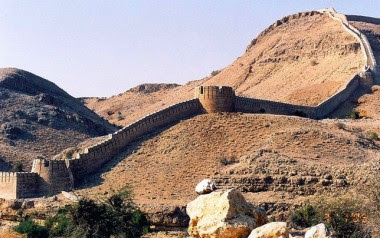
Is this Great Wall of China?

No. It's Wall of Sindh in Ranikot [3 hrs drive from Karachi].
It's the part of one of the Largest Fort in World, Fort of Ranikot.
This is an amazing view of a tunnel and bridge over a river on the railway track from "Rohri to Quetta".
This track passes through 20 tunnels and over 368 bridges.
It's the longest Railway gradient of world, and most scenic Railway ride of Asia.

This track also extends from Quetta to Turkey through Iran!

Is this Grand Canyon or Texas?

No. It's Hingol National Park of Baluchistan, Pakistan. It got Mysterious Mud mountains, beautiful blue water Hingol river, desert and deep blue Arabian sea. [3.5 hrs drive from Karachi on Makran coastal highway.


The Grand Canyons of Sindh, 

And finally, something you don’t get to see everyday, a snapshot from my facebook wall. Something worth sending jitters down the spine! J
 

Thursday, August 4, 2011


This is the capable and beautiful nation of Pakistan, full of talents, full of pride, full of motivation ..... a nation to lead the world, inshallah!!

http://www.youtube.com/watch?v=WawXzU8IcxA&feature=related (helicopters being developed in Pakistan)

http://www.youtube.com/watch?v=10nuuu3-ZkM&feature=related (girls from Gilgit grab gold/silver medals)


Story of a Great Nation


Story of a Great Nation!


Once upon a time, there was a country in chaos. An undemocratic feudal system prevailed, corruption reigned supreme and the country was in an economic crisis. A group of people united by a rigid ideology brought down the government promising democratic and socialist reform.
Instead mass beheadings followed in a period known as The Terror where all freedom of speech was suppressed and even a whiff of suspicion meant execution without trial. The educated elite fled. And western nations launched a unified attack against the rudderless nation.
A military man defended his country’s borders and soon installed himself as the head of the government in a coup d’état. Several changes of governments, two devastating wars, an ignoble role in a genocide, the acquisition of nuclear power and political unrests later, the country finally was acknowledged as a bastion of liberty, equality and fraternity.
 
It took France 178 years to get its act together...We’ve only had 64. And no, we’re not Afghanistan!
 
 
5 Provinces, 12 languages, 10 Ethnic Groups.
 
Currently famous for Dead Politicians and Terror Attacks.
 
 
And not so famous for…
 
5th largest subtropical desert of the world....


6th Major Sea in the World

40 of the world's highest 50 mountains.

Including K2, The world's second highest and most dificult to climb

Archeological sites dating back to 6000BC
Endangered Species, such as…
 

Snow Leopard


Markhor


Blue Whale

Wooly Flying Squirrel

Indus Dolphin


One of the easiest ways to evade a nation is to demoralize its youth, demean its integrity and create differences between its people and its military.
And guess what... They are doing it perfectly fine!
 
Think about it...
Do think!
Pakistan Zindabad!
Regards

One of the 180 Million Cornered Tigers
Pakistan