Showing posts with label Pakistan Beauty. Show all posts

Monday, August 27, 2012

Pakistan as not seen on TV - Khyber Pakhtukhwah Province

PAKISTAN – As Not Seen On TV!

Khyber Pakhtunkhwah Province

On the way to Mohodand Lake – Swat

Jalkhed - The beautiful place in kaghan valley.

River-side hotel in Kalam Valley.

Amazing meadows in Swat Valley, Khyber Pakhtukhwa

Doodi Patsar Lake, Khyber Pakhtunkhwa

An evening view of Swat River, Swat Valley, Pakistan

Stunning view of Chitral Airport

Tuesday, May 29, 2012

Pakistan – As Not Seen on TV

Pakistan – As Not Seen on TV! 
Nature at its best – Ayubia National Park

http://mw2.google.com/mw-panoramio/photos/medium/50330710.jpg


Ayuba National Park (abbreviated Ayuba) protected area of ​​3,312 hectares (8,184 acres) located in the district of Abbottabad, Khyber Pakhtunkhwa, Pakistan. It was declared a national park named after the Muhammad Ayub Khan (1958-1969), the second president of Pakistan.

Area of ​​coniferous forest supports moderate and moderate and mixed deciduous forest with an average elevation of 8,000 feet (2,400 m) above sea level. Ayuba National Park is surrounded by seven large villages and small towns in four Thandiani, Nathiagali Khanspur. The Park and resort complex built Ayuba as a combination of four instead of mini-Khairi Gali Changle Gali, Khanspur Galyat.

https://blogger.googleusercontent.com/img/b/R29vZ2xl/AVvXsEi82Vx36lvLax4I9RSc8ZSmUYew7auQ0rOCmRCQdl0HXDB1S2nqKUSEXgzo5Jl84jpV0QjzR_lXoWW1PnAC7PXRK9wFHbDSMfFbEEGNFbg8_m41YH8BHl5Ng38m3z2eC6YOrRD-lGy9CgE/s1600/ayubia+chair+lift.jpg 

http://img.xcitefun.net/users/2010/08/211232,xcitefun-ayubia-1.jpg


The park has 104 species of plants. The main Cedrus deodara Floral, Blue Pine, Newry, fir, chestnut and oak. About 21 plants here related to 19 families are known for their medicinal properties. Many of those used in the treatment of jaundice, stomach ulcers, snake bites, infections, internal, diabetes and Chambal.

Some plants are known to have an effect on anti-cancer. In addition, some are used as insecticides and biological pesticides, mainly because of its nature insect repellent. Worldwide Fund for Nature launched an initiative here ethno-botany, to demonstrate the sustainable use of plant resources as a means of protecting biodiversity. The park is home to 203 species of birds. Many species of birds, including eagles, vultures, Sparrow Hawk and may Pigeon Hill, among other things to get here. It also houses some of the rarer species such as pheasant and the Himalayan pheasant Koklass Kalij. Ayuba national park supports 31 species of mammals.

Standing about 26 km from the tourist resort of Murree Hill Station, more than 100,000 tourists visit the national park and the surrounding areas Ayuba each year. Since this region attracts many tourists every year a large number of hotels and restaurants around the park. And walking paths, hiking areas, picnic and motels, occupies a central place Ayuba chairlift that takes visitors to a nearby summit for a view of wooded hills. This was the first chair leisure facilities of its kind in Pakistan and remains a major attraction for domestic tourists. The PTDC Motel is famous here.

Friday, April 13, 2012

A unique world in the heart of Khirthar- Sindh


Following are images from Khirthar mountains and surrounding areas in Sindh, Pakistan.

Recently, the Sujag Sansar team arranged a visit to Kachho and departed with the cavalcade of vehicles from Johi District Dadu. It is situated about 50 Kilometers away from Dadu District in Sindh.

The drive from Johi to Wahi was 28 km-long with mustard plants greeting us from each side of the road; waving yellow heads, swaying with the wind.
Our unseen destination was a wetland situated 8 km at the west of Wahi.

Kaccho was a beautiful place with herdsmen wandering around with their cattle of goats, camels and buffaloes, surrounded by fertile cultivated lands.
The gypsies too have erected their tents on the sides of the roads. The lives of the gypsies is rather unique; they descend from mountainous areas to the plains of Kachho along with their herds of sheep and goats to graze on abundant natural and cultivated grass.

In the south of Pat Suleman stands a historical cemetery.

On the north side of the road, five or six imposing monuments can be seen, which go by the name of‘butta quba’ (without minarets or twin monuments).
At a distance ahead is another historical graveyard called Bakhar Shaheed.


The mesmerizing environment and natural beauty took away from the preoccupation of day to day drudgery business for a while and provided a break from all the worldly matters.

Protection of this enviroment can ensue tremendous economic activity and create hundreds of jobs for the locals.

A cave which was once home to people in the past.

A view from inside the cave.

View of Zoroastrian remains near Wahi-Pandhi


A view of Piprasar.


Men near mountains offering camel rides.


Huts to enjoy the beautiful scenery.


Fish swimming were visible in the clean waters.


Mountainous springs and torrents have been harnessed by locals using their wisdom for cultivation of chilies, tomatoes and more.


After crossing Wahi Pandhi one enters a world of mountains, while driving on the zigzag roads of pebbles.


A water fall at Bodo.


Though this trip was short lived, the impression left by the sceneries was a lasting one.


Saturday, August 6, 2011

The Pakistan We Never Knew!


Glaciar Pool, Pakistan.

The Baltoro and other glaciers of the Karakoram, Pakistan are the largest and longest in the world outside the polar region. From it's spectacular birthplace in Concordia, at the base of K-2 and the Gasherbrum range, the Baltoro Glacier flows for more than 59 kilometers, a rippling, pitted, pockmarked river of ice, where great glaciers slide and slither together before separating to go their different ways.
A Glacier Stream-The Baltoro Glacier, at 62 kilometers long, is one of the longest glaciers outside the polar regions. It is located in Baltistan, in the Gilgit-Baltistan region of Pakistan.
Altit Fort, Pakistan

It is an ancient fort in the Hunza valley in the Northern Areas of Pakistan.
The architectural style is a clear indication of Tibetan influence at those times.
Angoori, Pakistan.

This is not a scene from 'A Walk to Remember'. It is the Angoori Road, on the way to Murree.
Ayubia National Park, Pakistan.

The park supports one of the best examples of moist Himalayan temperate forest in Pakistan. It consists entirely of reserve forests, which spill out of the park area on the west and south sides. The scenery is superb with huge pine forests covering the hills and providing shelter to the larger and smaller mammals.

Large varieties of beautiful birds, animals, plants adorn this green place. Hill cats can be spotted while brown monkey are a common scene. Yellow beaked magpie, red and yellow body finches, white cheeked or crested grey finch and many other species of birds make the park their home.
BataKundi, Pakistan.

It is the most beautiful area of Kaghan Valley just a few kms away from Naran.
 
Chitta Khatta Lake, Pakistan.

One of the most wonderful treks where you start from Kaghan and end up in Neelam.
Like any other population of the subcontinent it has the most heterogeneous population with variety of rituals, customs and traditions. The whole valley is full of beautiful and fascinating scenes!
Gadani Beach is the location of Gadani ship-breaking yard, which is one of the world's largest ship-breaking yards.
Pakistan Zindabad!

Regards

One of the 180 Million Cornered Tigers
Pakistan.

Friday, August 5, 2011

PAKISTAN - As Not Seen on TV


The Mohatta Palace, Pakistan.

It is located in Karachi, Pakistan. It was built by Shivratan Chandraratan Mohatta. The palace has an area of 18,500 sq ft [1,720 m2] and its facade is trimmed with windows, stone brackets, spandrels, domes, balustrades with floral motifs and exquisite railings. The "barsati” (terrace) of the Mohatta Palace had a beautiful family temple dedicated to Hindu God, lord Shiva.

What many do not know about the Mohatta Palace is the secret underground tunnel that leads from the grounds of the palace all the way to a subterranean Hindu temple less than a kilometer away. Various stories allege the presence of supernatural happenings at the Mohatta Palace as well!
Darbar Mahal, Pakistan.

Darbar Mehal is one of the hidden gems of Bahawalpur, since not many know about it. It was built in 1872 like an Italian chateau on neoclassical lines, at a time when modernism had set in. It belonged to the Nawab of Bahawalpur princely state, during British Raj.
The Faiz Mahal, Pakistan.

Commissioned by Talpur dynasty, it is reminiscent of the glory days of Khairpur state. It was built in 1798 as the palace of the Talpur family.

Kachura Lake, Pakistan.

Skardu, Gilgit-Baltistan
Max. depth 70 metres [230 ft]
Surface elevation 2,500 metres [8,200 ft]

The Kachura Lakes are two lakes in the Skardu District of Gilgit-Baltistan, northern Pakistan. The lakes are in the Karakoram mountain range of the western Himalayas, the greater Kashmir region, and in the Indus River basin.
Rohtas Fort, Pakistan.

Rohtas Fort is a formidable structure built over hillocks and looking out at what is left of Jhelum river, Grand Trunk Road runs from Calcutta to Kabul. It is one of the best known highways of the ancient times and still lot of travelers wish to travel by it.

Today, Rohtas is the pride of Pakistan and one of the eight World Heritage Sites of UNESCO.

The Kingdom which is seldom visited known as Karakorum, Pakistan.

The Karakoram and the Himalaya are important to Earth scientists for several reasons. They are one of the world's most geologically active areas, at the boundary between two colliding continents. Therefore, they are important in the study of plate tectonics.

A significant part, 28-50% of the Karakoram Range is glaciated, compared to the Himalaya (8-12%) and European Alps (2.2%). Mountain glaciers may serve as an indicator of climate change, advancing and receding with long-term changes in temperature and precipitation.
Silk route, on the way to Gilgit, Pakistan.

For centuries, Gilgit has been the stopping point on the Silk Route as caravans journeyed south from Kashgar. Chinese monks returning from pilgrimages in India in the 5th century found Buddhism widely practiced in Gilgit. Hinduism came to the area around the 10th century, followed by Islam two hundred years ago.

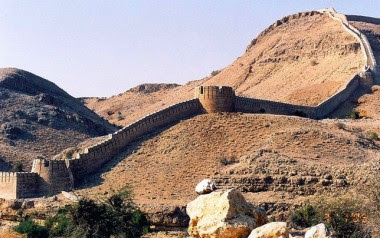
Is this Great Wall of China?

No. It's Wall of Sindh in Ranikot [3 hrs drive from Karachi].
It's the part of one of the Largest Fort in World, Fort of Ranikot.
This is an amazing view of a tunnel and bridge over a river on the railway track from "Rohri to Quetta".
This track passes through 20 tunnels and over 368 bridges.
It's the longest Railway gradient of world, and most scenic Railway ride of Asia.

This track also extends from Quetta to Turkey through Iran!

Is this Grand Canyon or Texas?

No. It's Hingol National Park of Baluchistan, Pakistan. It got Mysterious Mud mountains, beautiful blue water Hingol river, desert and deep blue Arabian sea. [3.5 hrs drive from Karachi on Makran coastal highway.


The Grand Canyons of Sindh, 

And finally, something you don’t get to see everyday, a snapshot from my facebook wall. Something worth sending jitters down the spine! J